
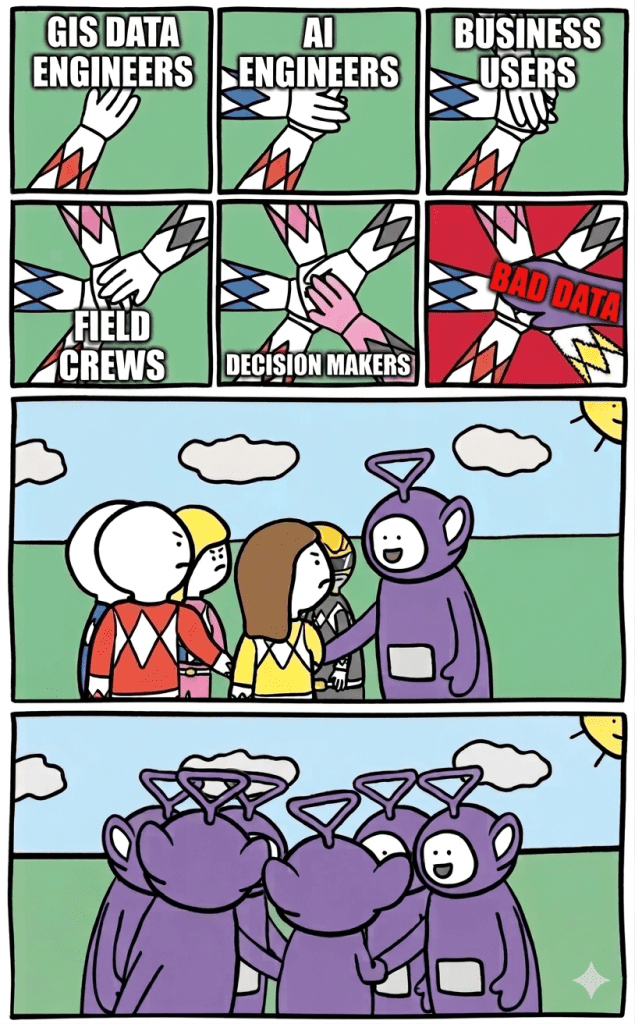
In today’s utility and network-driven environments, data is more than just information—it is the backbone of decision-making. Within GEV Smallworld GNM, the quality of your data directly impacts operational efficiency, analytics, and overall system performance.
Understanding the difference between good data and bad data is the first step toward building a GEV Smallworld GNM environment that truly works.
🟢 What is Good Data?
Good data is information that is accurate, complete, consistent, and aligned with real-world conditions. It maintains proper topology and enables reliable network analysis — empowering teams to make effective, confident decisions.
🔴 What is Bad Data?
Bad data is information that is outdated, duplicated, inconsistent, or misaligned with physical conditions. It often contains topology errors and leads to unreliable analysis, flawed reporting, and poor operational decisions.
⚠️ The Impact of Bad Data
Poor data quality does not stay confined to your database. It cascades across every layer of your operations. Common consequences include:
- Network inconsistencies
- Incorrect spatial analysis
- Invalid reporting outputs
- Inefficiencies in field operations
- Reduced system performance
These issues not only disrupt workflows but also increase operational costs and risks.
🔍 Root Causes
Understanding the source of the problem is key to resolving it. Common causes include:
- Unmanaged data updates
- Accumulation of legacy data
- Data migration challenges
- Lack of validation and QA/QC processes
Without proper governance, these factors gradually degrade data quality over time.
⚙️ The RedPlanet Approach
At RedPlanet Solutions, we address data quality in GEV Smallworld GNM through a structured, end-to-end methodology — moving from diagnosis to resolution with precision and accountability.
- Validate data for accuracy, completeness, consistency, and topology integrity across the network model.
- Profile data to identify duplicates, attribute issues, and topology errors at scale.
- Classify and isolate low-quality data for targeted, prioritized handling.
- Apply automated and semi-automated correction workflows to efficiently resolve known issues.
- Perform remediation for complex data issues that require expert intervention.
- Ensure structured QA/QC validation before data is posted back to production environments.
This comprehensive approach ensures that data is not only corrected but also sustained at high quality levels.
📈 The Outcome
When data quality is managed systematically, the benefits propagate across your entire GEV Smallworld GNM ecosystem:
- Data Integrity: Improved reliability across all data assets, reducing errors at the source.
- Analytics & Reporting: Reliable, accurate insights that decision-makers can trust.
- Network Operations: Optimized field workflows with fewer inefficiencies and rework.
- System Performance: Stable, consistent performance across integrations and downstream systems.
- Decision Quality: Better strategic and operational decisions driven by high-quality, trustworthy data.
Your GIS is not just a system—it’s a decision engine.
The quality of your data defines the quality of your outcomes.